Showing posts with label Penguin. Show all posts

Wednesday, January 03, 2018

"Making Sense of God 6d" (Tim Keller)


TITLE: Making Sense of God: An Invitation to the Skeptical
AUTHOR: Tim Keller
PUBLISHER: New York, NY: Viking Books, 2016, (330 pages).

Who am I? Who are you? Often, the answer depends on our upbringing, our links to certain institutions, or our roles and titles. In non-Western cultures, people are identified through their connections with their communities. In Western cultures, this is reversed via "expressed individualism." While it may be overly simplistic, this offers us a glimpse into the differences in mindset that contrasts "self-sacrifice" from "self-assertion"; Keller even points out the hit movie Frozen's song that affirms the latter in Western culture. With secularism, the image of the modern man has become incoherent, illusory, crushing, and fracturing.

Question 6d: "The Problem with the Self: Question of Identity"
On Fracturing:
"In the last chapter we talked about how the secular view of freedom as the absence of restrictions undermines community. Taylor argues (and Bellah demonstrates) that the secular view of identity and self does the same thing. This view, argues Taylor, reduces relationships and community to things 'purely instrumental in their significance.' In traditional cultures our most crucial relationships are more important than our individual self-interest, because our identity depends on honoring the relationships. Therefore they are inviolate and we are solidly embedded in them. A traditional human community according to Bellah, was 'an inclusive whole, celebrating the interdependence of public and private life.'

But when, as in the modern approach, you bestow significance on yourself, then your individual interests are more important than any social tie. If a relationship is satisfying to you, you keep it only so long as it pleases you. 'It fosters a view of relationships in which these ought to subserve personal fulfillment. The relationship is secondary to the self-realization of the partners. On this view, unconditional ties, meant to last for life, make little sense. Human communities become thinned out into 'lifestyle enclaves' or 'social networks' in which people connect, flexibly and transiently, only to people like themselves. They relate to one another around similar tastes in music or food or common wealth status (such as in a gated housing development), but their private and public lives are no one else's business. It is well documented that under the conditions of the modern, individualistic self, social ties and institutions are eroding, marriage and family are weakening, society is fragmenting into warring factions, and economic inequality is growing." (131-132)


c

Wednesday, December 27, 2017

"Making Sense of God 6c" (Tim Keller)


TITLE: Making Sense of God: An Invitation to the Skeptical
AUTHOR: Tim Keller
PUBLISHER: New York, NY: Viking Books, 2016, (330 pages).

Who am I? Who are you? Often, the answer depends on our upbringing, our links to certain institutions, or our roles and titles. In non-Western cultures, people are identified through their connections with their communities. In Western cultures, this is reversed via "expressed individualism." While it may be overly simplistic, this offers us a glimpse into the differences in mindset that contrasts "self-sacrifice" from "self-assertion"; Keller even points out the hit movie Frozen's song that affirms the latter in Western culture. With secularism, the image of the modern man has become incoherent, illusory, crushing, and fracturing.

Question 6c: "The Problem with the Self: Question of Identity"
On Crushing:
The problem with the modern self is:

"Ironically, the apparent freedom of secular identity brings crushing burdens with it. In former times, when our self-regard was more rooted in social roles, there was much less value placed on competitive achievement. Rising from rags to riches was nice but rare and optional. It was quite sufficient to be a good father or mother, son or daughter, and to be conscientious and diligent in all your work and duties. Today, as Alain de Botton has written, we believe in the meritocracy, that anyone who is of humble means is so only because of a lack of ambition and savvy. It is an embarrassment now to be merely faithful and not successful. This is a new weight on the soul, put there by modernity. Success or failure is now seen as the individual's responsibility alone. Our culture tells us that we have the power to create ourselves, and that puts the emphasis on independence and self-reliance. But it also means that society adulates winners and despises losers, showing contempt for weakness.

All this produces a pressure and anxiety beyond what our ancestors knew. We have to decide our look and style, our stance and ethos. We then have to promote ourselves and be accepted in the new space - professional, social, aesthetic - in which we have chosen to create our selves. As a result, 'new modes of conformity arise' as people turn themselves into 'brands' through the consumer goods they buy.
....

The self-made identity, based on our own performance and achievement in ways that older identities were not, makes our self-worth far more fragile in the face of failure and difficulty.

....

In the New York Times, Benjamin Nugent writes about the struggles he had when he was a full-time novelist. He says:
"When good writing was my only goal in life, I made the quality of my work the measure of my worth. For this reason, I wasn't able to read my own writing well. I couldn't tell whether something I had just written was good or bad, because I needed it to be good in order to feel sane. I lost the ability to cheerfully interrogate how much I liked what I had written, to see what was actually on the page rather than what I wanted to see or what I feared to see."
When his identity was based on being a good writer, it made him a worse writer. He announces at the end of the article that he doesn't base his self on writing anymore because he 'fell in love, an overpowering diversion.' But is the love of someone else a better basis for an identity?

....

If we base our identity on love we come to the same cul-de-sac that we saw with the novelist who got his identity from work. Just as he could not beat poor work, so we will not be able to handle the problems in our love relationships. The writer had to believe he is a great writer in order to be sane. We will have to believe our love relationship is okay - if it goes off the rails, we lose our sanity. Why? If our identity is wrapped up in something and we lose it, we lose our very sense of self. If you are getting your identity from the love of a person - you won't be able to give them criticism because their anger will devastate you. Nor will you be able to bear their personal sorrows and difficulties. If they have a problem and start to get self-absorbed and are not giving you the affirmation you want, you won't be able to take it. It will become a destructive relationship. The Western understanding of identity formation is a crushing burden, both for individuals and society as a whole." (128-130)


c

Wednesday, December 20, 2017

"Making Sense of God 6b" (Tim Keller)


TITLE: Making Sense of God: An Invitation to the Skeptical
AUTHOR: Tim Keller
PUBLISHER: New York, NY: Viking Books, 2016, (330 pages).

Who am I? Who are you? Often, the answer depends on our upbringing, our links to certain institutions, or our roles and titles. In non-Western cultures, people are identified through their connections with their communities. In Western cultures, this is reversed via "expressed individualism." While it may be overly simplistic, this offers us a glimpse into the differences in mindset that contrasts "self-sacrifice" from "self-assertion"; Keller even points out the hit movie Frozen's song that affirms the latter in Western culture. With secularism, the image of the modern man has become incoherent, illusory, crushing, and fracturing.

Question 6b: "The Problem with the Self: Question of Identity"
On Illusory:
The problem with the modern self is:

"In short, do not look to anyone else to validate you. Use no standards from the outside. You bestow the verdict of significance on yourself. But this is an impossibility. You cannot get an identity through self-recognition; it must come in a great measure from others. Theologian Philip Ryken qyotes fmor a contemporary novel about a young single woman. She writes a New Year's resolution: 'Develop inner poise and authority and sense of self as a woman of substance, complete without boyfriend, as best way to obtain boyfriend.' However, she sees a problem. 'My sense of self comes not from other people but from . . . myself? That can't be right.' Yes, it isn't right. In fact, it can't be done.

....

Robert Bellah says strikingly, 'The irony is that here, too, just where we [modern people] think we are most free, we are most coerced by the dominant beliefs of our own culture. For it is a powerful cultural fiction that we not only can, but must, make up our deepest beliefs in the isolation of our private selves.' He goes on to say that modern people simply cannot see how their identities owe to others. 'Insofar as they are limited to a language of radical autonomy' and 'cannot think about themselves or others except as arbitrary centers of volition,' it means 'they cannot express the fullness of being that is actually theirs.'

Our identity then, is not, after all, something we can bestow on ourselves. We cannot discover or create an identity in isolation, merely through some kind of internal monologue. Rather, it is negotiated through dialogue with the moral values and beliefs of some community. We find ourselves in and through others. 'We never get to the bottom of ourselves on our own. We discover who we are face to face and side by side with others in work, love, and learning.' In the end the contemporary identity - simply expressing your inner feelings, with a valuation bestowed on yourself independently - is impossible.


" (125-6)


c

Wednesday, December 13, 2017

"Making Sense of God 6a" (Tim Keller)


TITLE: Making Sense of God: An Invitation to the Skeptical
AUTHOR: Tim Keller
PUBLISHER: New York, NY: Viking Books, 2016, (330 pages).

Who am I? Who are you? Often, the answer depends on our upbringing, our links to certain institutions, or our roles and titles. In non-Western cultures, people are identified through their connections with their communities. In Western cultures, this is reversed via "expressed individualism." While it may be overly simplistic, this offers us a glimpse into the differences in mindset that contrasts "self-sacrifice" from "self-assertion"; Keller even points out the hit movie Frozen's song that affirms the latter in Western culture. With secularism, the image of the modern man has become incoherent, illusory, crushing, and fracturing.

Question 6a: "The Problem with the Self: Question of Identity"
On Incoherent:
"First of all, our contemporary approach is incoherent. If you look into your heart to find your deep desires, you certainly will discover many of them. And you will discover something else - that they contradict one another. You may very much want a certain career, but then you fall in love with someone whom you also want very much. Because of the particular nature of both the career and the relationship, you realize you won't be able to have both. What you you going to do? You might insist that one of these desires - for career or love - must be deeper and more 'you,' but that's naive. Why assume that your internal desires are arranged in such an orderly way? Francis Spufford writes that you are 'a being whose wants make no sense, don't harmonise: whose desires, deep down, are discordantly arranged, so that you truly want to possess and you truly want not to, at the same time. You're equipped. . . for farce or even tragedy more than you are for happy endings.

.....

Not only do your desires contradict, but they also are elusive. 'What are the wants of the self?' Bellah asks. 'For all its unmistakable presence and intensity on occasion, the experience of feeling good, like being in love, is so highly subjective that its distinguishing characteristics remain ineffable.'

And besides being contradictory and elusive, our desires constantly change. As I have said, part of having an identity is having a stable, core sense of who you are, day in and day out, in different settings and times. That is why the traditional way of forging an identity through connection with something solid outside the individual self made sense. But if your identity is just your desires, they are going to be changing all the time. If in every situation you seek your own self-interest responding in ways that get the approval and control you want at the moment, then identity essentially disappears. 'In the work of Erving Goffman. . . [comes the view that] there is no self at all. What seems to be a self is merely a series of emphasis on 'being yourself' apart from fixed social roles results in there being no sustained 'you' left, which is common to all situations." (123-4)


c

Wednesday, December 06, 2017

Midweek Meditation: "Making Sense of God 5" (Tim Keller)


TITLE: Making Sense of God: An Invitation to the Skeptical
AUTHOR: Tim Keller
PUBLISHER: New York, NY: Viking Books, 2016, (330 pages).

Freedom is a much cherished right in the West. The progress of a society is intricately linked to the freedom to what whatever one pleases. Anything that infringes on such a freedom would be blasted as evil. If one elevates freedom to the highest importance, all others will have to play second fiddle to this sacred right. Truth is, is this workable? What if the exercise of one's freedom infringes on another person's expression of freedom? Is there a limit to free-will?

Question 5: "Why Can't I Be Free to Live as I See Fit, as Long as I Don't Harm Anyone?"
"If you see a large sailboat out on the water moving swiftly, it is because the sailor is honoring the boat's design. If she tries to take it into water too shallow for it, the boat will be ruined. The sailor experiences the freedom of speed sailing only when she limits her boat to the proper depth of water and faces the wind at the proper angle. In the same way, human beings thrive in certain environments and break down in others. Unless you honour the givens and limits of your physical nature, you will never know the freedom of health. Unless you honor the givens and limits of human relationships, you will never know the freedom of love and social peace. If you actually lived any way you wanted - never aligning your choices with these physical and social realities - you would quickly die, and die alone.

You are, then, not free to do whatever you choose. That is an impossible idea and not the way freedom actually works. You get the best freedoms only if you are willing to submit your choices to various realities, if you honor your own design." (103)

"In their book Bellah and his colleagues show that much of the health of a society depends on voluntarily unselfish behavior. Being honest, generous, and public spirited - being faithful to your spouse and children - regularly infringes on your personal happiness and freedom. If people stop doing these things and (as Haidt says) put personal fulfillment above commitment and relationship, the only alternative is a more powerful and coercive government. Bellah and his colleagues made this case in their original 1985 study. Their case was that the culture's emphasis on personal freedom over commitment to community could undermine democractic institutions. In 1996 and 2008 the book was reissued with a new preface written by Bellah, and each time he pointed out that our situation was worsening.

Let's bring this down to a practical level. Just as a sailboat is not free to sail unless it confines itself in significant ways, so you will never know the freedom of love unless you limit your choices in significant ways. There is no greater feeling of liberation than to feel and be loved well. The affirmation that comes from love liberates you from fears and self-doubts. It frees you from having to face the world alone, with only your own ingenuity and resources. Your friend or mate will be crucial to helping you achieve many of your goals in life. In all these ways love is liberating - perhaps the most liberating thing. But the minute you get into a love relationship, and the deeper and the more intimate and the more wonderful it gets, the more you also have to give up your independence." (107)

One of the most powerful links between God, love, and freedom is written by John Newton as follows:

"Our pleasure and our duty, though opposite before;
Since we have seen his beauty, are joined to part no more...
To see the law of Christ fulfilled, and hear his pardoning voice
Changes a slave into a child, and duty into choice."


c

Wednesday, November 29, 2017

Midweek Meditation: "Making Sense of God 4" (Tim Keller)


TITLE: Making Sense of God: An Invitation to the Skeptical
AUTHOR: Tim Keller
PUBLISHER: New York, NY: Viking Books, 2016, (330 pages).

Keller continues to invitation to a discussion with the next chapter about happiness and true contentment. He skillfully dissects the four key strategies secular people use to smother their underlying levels of discontent. He critiques firstly the strategies of youth where one thinks that by getting the right job, the right love partner, the right qualifications and so on, one would be happy. Truth is, these are basic distractions from the true pursuit of meaning. Secondly, we complain about the barriers preventing us from getting at our perceived goals of happiness. Thus we resent and believe that our path to happiness is to eliminate these barriers. This too is temporary. Thirdly, we become driven people to accumulate all kinds of possessions and accomplishments. Unfortunately, this is like that running on a treadmill where we have a lot of activity but does not progress in terms of physical distance. Like the physical treadmill, once we tire, we stop. Fourthly, we may adopt the strategy of despairing in which we no longer blame others but ourselves.

Other religions try to resolve such discontent through altruism (just keep doing good no matter how empty we feel); or cynicism (hardening one's heart about the non-existence of good meaning and purpose); or detachment (to escape). Keller then produces a powerful argument for God and love.

Question 4: "How Can We Be Happy?"
"There is another powerful dimension to this reordering of loves. Paul Bloom, in his book How Pleasure Works, argues that what matters most for pleasure is not the simple impact on our senses but what it means in relationship to other persons who matter to us. A painting that we think is an original by an admired artist gives less pleasure when we find out it is not. A chair may be comfortable, but if it is our mother's favorite chair from her sitting room, it will give us even more pleasure. To use theological language, 'we enjoy things most when we experience them as a sacrament - as carriers of the presence of another.' " (93)

"Here, then, is the message. Don't love anything less; instead learn to love God more, and you will love other things with far more satisfaction. You won't overprotect them, you won't overexpect things from them. You won't be constantly furious with them for not being what you hoped. Don't stifle passionate love for anything; rather, redirect your greatest love toward God by loving him with your whole heart and love him for himself, not just for what he can give you. Then, and only then, does the contentment start to come. That is the Christian view of satisfaction. It avoids the pitfalls of both the ancient strategy of tranquillity through detachment and the modern strategy of happiness through acquisition. It both explains and resolves the deep conundrum of our seemingly irremediable discontent." (94)

c

Wednesday, November 22, 2017

Midweek Meditation: "Making Sense of God 3" (Tim Keller)


TITLE: Making Sense of God: An Invitation to the Skeptical
AUTHOR: Tim Keller
PUBLISHER: New York, NY: Viking Books, 2016, (330 pages).

Continuing the excerpts from Keller's very wise take on secularism and religion,

Question 3: "Is Meaning in Life Without God Practically Possible?"
A growing number of skeptics are insisting on the freedom to think and believe in anything they choose. With such a heavy reliance on humanistic thinking, the question Keller poses the question of meaning and God, beginning with a possible yes before concluding with a larger no. Note how Keller inserts the word 'practically' into the question.

"So is meaning in life without God practically possible? Public discourse is filled with loud religious voices insisting that life without God is inevitably pointless, bleak, and unworkable. On the other side there are plenty of secular people who insist that they not only have satisfying meaning in life but also have a kind of freedom that religious people do not. Who is right? Can we have meaning in life without any belief in God at all? To be fair to all, I would argue that the answer is both yes and no.

I say yes because both by our definition and by lived experience secular people can certainly know meaning in life. We defined 'meaning' as having both a purpose and the assurance that you are serving some good beyond yourself. If you decide that the meaning of your life is to be a good parent, or to serve a crucial political cause, or to tutor underprivileged youth, or to enjoy and promote great literature - then you have, by definition, a meaning in life. Plenty of secular people live like this without being tortured or gloomy in the manner of a Camus. It is quite possible to find great purpose in the ordinary tasks of life, apart from knowing answers to the Big Questions About Existence.

But I also say no. Secular people are often unwilling to recognize the significant difference between what have been called 'inherent' and 'assigned' meanings. Traditional belief in God was the basis for discovering, objective meaning - meaning that is there, apart from your inner feelings or interpretations. If we were made by God for certain purposes, then there are inherent meanings that we must accept.

The meanings that secular people have are not discovered but rather created. They are not objectively 'there.' They are subjective and wholly dependent on our feelings. You may determine to live for political change or the establishment of a happy family, and these can definitely serve as energizing goals. However, I want to argue that such created meanings are much more fragile and thin than discovered meanings. Specifically, discovered meaning is more rational, communal, and durable than created meaning." (64-65)

c

Wednesday, November 15, 2017

Midweek Meditation: "Making Sense of God 2" (Tim Keller)


TITLE: Making Sense of God: An Invitation to the Skeptical
AUTHOR: Tim Keller
PUBLISHER: New York, NY: Viking Books, 2016, (330 pages).

Continuing the excerpts from Keller's very wise take on secularism and religion,

Question 2: "Isn't Religion Based on Faith and Secularism on Evidence?"
Keller puts his finger on this common misconception and argues that it is not an absolute truth that secularism is a search for truth and empirical evidence. In fact, secularism has a profound level of dependence on faith that is often not highlighted. He argues that Christianity is both faith and reason. It is highly arrogant of secularists to insist that only their way of thinking is rational.

"Twentieth century thinkers such as Martin Heidegger, Maurice Merleau-Ponty, Ludwig Wittgenstein have argued that all reasoning is based on prior faith commitments to which one did not reason. . . .

For example, American philosopher C. Stephen Evans writes, 'Science by its very nature is not fit to investigate whether there is more to reality than the natural world.' Because science's baseline methodology is to always assume a natural cause for every phenomenon, there is no experiment that could prove or disprove that there is something beyond this material world. For example, there would be no way to empirically prove that a miracle has occurred since a scientist would have to assume, no matter what, that no natural cause had been discovered yet. If there actually had truly been a supernatural miracle, modern science could not possibly discern it." (Keller, 34-35)

"The Christian believer is using reason and faith to get to her beliefs just as her secular neighbor is using reason and faith to get to hers. They are both looking at the same realities in nature and human life, and both are seeking a way to make the best sense of them through a process that is rational, personal, intuitive, and social. Reason does not and cannot operate alone. Contemporary secularity, then, is not the absence of faith, but is instead based on a whole set of beliefs, including a number of highly contestable assumptions about the nature of proof and rationality itself." (41)

c

Wednesday, November 08, 2017

Midweek Meditation: "Making Sense of God 1" (Tim Keller)

Starting this week, I will be sharing a few excerpts from Tim Keller's recent book, "Making Sense of God."

TITLE: Making Sense of God: An Invitation to the Skeptical
AUTHOR: Tim Keller
PUBLISHER: New York, NY: Viking Books, 2016, (330 pages).

In New York, almost everybody seem to be talking about Tim Keller and Redeemer Presbyterian Church. One reason for his success with many people, both believers and non-believers is his ability to connect with people living in a secular and skeptical age, yet maintaining his commitment about faith, hope, and God. Recently retired, he continues his ministry largely through writing.

Question 1: "Isn't Religion Going Away?"
Absolutely not. In a striking counter-observation of the presumed rise of secularism, Keller notes two reasons why secularism itself is shrinking.

"Why? There are two basic reasons. One has to do with the trends of retention and conversion. Many point to the rising percentage of younger adult 'nones' in the United States as evidence for the inevitable shrinkage of religion. However, Kaufmann shows that almost all of the new religiously unaffiliated come not from conservative religious groups but from more liberal ones. Secularization, he writes, 'mainly erodes . . . the taken-for-granted, moderate faiths that trade on being mainstream and established.' Therefore, the very 'liberal, moderate' forms of religion that most secular people think are the most likely to survive will not. Conservative religious bodies, by contrast, have a very high retention rate of their children, and they convert more than they lose.

The second main reason that the world will become more religious is that religious people have significantly more children, whereas the more irreligious and secular a population, the less often marriage happens and the smaller the families. This is true across the world and holds within every national group, within every educational level, and within every economic class. So, for example, it is not the case that always 'the more children, the better.' Columbia economist Jeffrey Sachs has argued well that overpopulation and exorbitant birthrates are major contributing factors to world poverty. Nevertheless, it would be a mistake to think there is no opposite problem. Cultures that do not have a replacement-level birthrate die out as they are displaced by other populations and cultures. As Kaufmann and others show, the most secular societies are maintained through the immigration of more religious peoples.
...

It turns out, then, that the individualism of modern culture does not necessarily lead to a decline in religion. Rather, it leads to a decline of inherited religion, the sort one is born into." (Keller, 24-27)

c

Wednesday, April 05, 2017

Midweek Meditation: "The Prodigal God" (Tim Keller)

For the month of April, I will be sharing snippets from Tim Keller's excellent book, "The Prodigal God." Today, I am amazed at how Keller links the normal understanding of this parable about the two sons to the two audiences.

c


TITLE: The Prodigal God: Recovering the Heart of the Christian Faith
AUTHOR: TIM KELLER
PUBLISHER: New York, NY: Dutton Press, 2008, (144 pages).

"Most readings of this parable have concentrated on the flight and return of the younger brother - the 'Prodigal Son.' That misses the real message of the story, however, because there are two brothers, each of whom represents a different way to be alienated from God, and a different way to seek acceptance into the kingdom of heaven.

It is crucial to notice the historical setting that the author provides for Jesus' teaching. In the first two verses of the chapter, Luke recounts that there were two groups of people who had come to listen to Jesus. First there were the 'tax collectors and sinners.' These men and women correspond to the younger brother. They observed neither the moral laws of the Bible nor the rules for ceremonial purity followed by religious Jews. They engaged in 'wild living.' Like the younger brother, they 'left home' by leaving the traditional morality of their families and of respectable society. The second group of listeners was the 'Pharisees and the teachers of the law,' who were represented by the elder brother. They held to the traditional morality of their upbringing. They studied and obeyed the Scriptures. They worshiped faithfully and prayed constantly." (7-8)

Monday, April 14, 2014

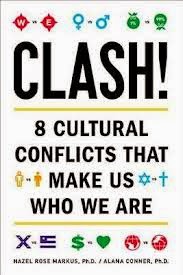
BookPastor >> "Clash!" (Hazel Rose Markus and Alana Conner)

TITLE: Clash!: 8 Cultural Conflicts That Make Us Who We Are
AUTHOR: Hazel Rose Markus and Alana Conner
PUBLISHER: New York, NY: Hudson St Press, 2013, (320 pages).

As the world becomes more inter-connected, people will increasingly cross paths. Various people groups will intermarry and cultures will merge and adapt to each other. In many situations, they may even clash and produce conflicts never encountered before. In view of the inevitable conflicts, maybe the road ahead is not to arm ourselves with weapons but to wear the hats of understanding wherever we go. We anticipate changes. We welcome diversity. We seek first to understand than to be understood. This is where this book comes in. The key idea is, because cultural conflicts make us who we are, it is imperative to come up right through constructive interactions and engagements.

In an insightful study of eight different cultural conflicts, the authors who are also cultural psychologists describe the differences, reveal the various perspectives, and how we can understand the differences so that we can not only better appreciate them, but to learn to live and let live where necessary. At the root of their quest is the desire to locate ourselves and to find our identity that is being shaped by these cultural clashes. Describing the left side culture in terms of "I" (self, mind, psyche, and soul), and right-side "culture cycle" in terms of (I's, Interactions, Institutions, and Ideas), the authors contend that culture shaping begins from the left, conditioning the right, which in turn perpetuate this cycle. What if the shaping is non-constructive but destructive? What if our cultural blindness leads to misunderstanding and wars? Differences indeed can annoy people. What is needed is to break this negative culture cycles and to replace them with positive constructive efforts to live together well in eight ways.  

Latest Posts

Headlines