Showing posts with label Religion. Show all posts

Monday, May 21, 2018

BookPastor >> "God Among Sages" (Kenneth Richard Samples)

This review was published at Panorama of a Book Saint on July 5th, 2017.

c

TITLE: God among Sages: Why Jesus Is Not Just Another Religious Leader
AUTHOR: Kenneth Richard Samples
PUBLISHER: Grand Rapids, MI: Baker Books, 2017, (288 pages).

Who is Jesus? Is he simply another religious leader like those of the other major religions of the world? Who does he claim he is? Is he God? This book sets out the facts and compares the various philosophies, religions, worldviews in this world of pluralistic thinking and beliefs. Author Kenneth Richard Samples asserts that Jesus is matchless throughout history in terms of his self-understanding; his identity; his way of life and consistency in teaching. Part One essentially deals with what Jesus talks about himself. Part Two deals with the lives and accomplishments of four major religions and then each is compared with Jesus. The four major religious leaders are Krishna (Hinduism); Buddha (Buddhism); Confucius (Confucionism); and Muhammad (Islam). Part Three goes beyond these four religions to cover a bigger sphere of the world's perspective on Jesus. This includes the different types of pluralistic beliefs; tolerance/intolerance; inclusivism/exclusivism; and many more. Simply put, this book is about understanding who the Person if Jesus is both to Christians, other religions, and the world at large. Though not all perspectives are covered, the selected ones represent a large proportion of the world.


Wednesday, April 18, 2018

Midweek Meditation: "On Religion" (Billy Graham)


Billy Graham passed away on Feb 21st, 2018. He has seen many decades of cultural change. One of the most difficult is the postmodern period of skepticism and doubt. Hear what Graham has to say about religion.
  • "Something distinguishes Christianity from all the religions of the world. Not only does it carry the truth of the redemption, by the death of our Savior for our sins on the cross, but it carries the fact that Christ rose again."
  • "We see that humanism has become for many a polite name for a vocal, aggressive, influential crusade against religion in the name of social and moral advance. There is nothing new about humanism. It is the yielding to Satan's first temptation of Adam and Eve: 'Ye shall be as gods.' Genesis 3:5"
  • "There are many bibles of different religions; there is the Mohammedan Koran, the Buddhist Canon of Sacred Scripture, the Zoroastrian ZendAvesta, and the Brahman Veda . . . they all began with some flashes of true light, and end in utter darkness. Even the most casual observer soon discovers that the Bible is radically different. It is the only Book that offers redemption to us and points the way out of our dilemma."
  • "Nothing seems to satisfy. Not politics, not education, not material goods. Some who refuse to turn their hearts toward God have created the New Age movement, with all of its aberrations. This is actually not new but only the latest attempt by man to place something other than Christ inside himself in a futile attempt to satisfy spiritual longings."
  • "Some Christian leaders . . are willing to give up some of the teachings of the Bible in order to harmonize Christianity with the other religions."
c

Monday, January 15, 2018

BookPastor >> "The Altars Where We Worship" (Juan M. Floyd-Thomas, Stacey M. Floyd-Thomas, Mark G. Toulouse)

This review was first published at Panorama of a Book Saint on Feb 21st, 2017.

conrade

TITLE: The Altars Where We Worship: The Religious Significance of Popular Culture
AUTHOR: Juan M. Floyd-Thomas, Stacey M. Floyd-Thomas, Mark G. Toulouse
PUBLISHER: Louisville, KY: Westminster John Knox Press, 2016, (225 pages).

It has been said of the Israelites who had left Egypt: "You can take Israel out of Egypt, but you cannot take Egypt out of Israel." This parallels the way Christians interact with the world. We can take Christians out of the world, but we cannot take the world out of a Christian. John Calvin once called the human heart as an "idol factory." The war against idolatry and the worship of idols continue to be fought through the centuries. In ancient times, we have the idols of Arianism, Dualism, Stoicism, Gnosticism, Dualism, and other deceptive philosophies. In modern times, we encounter more of the same in the form of individualism, consumerism, materialism, narcissism, and in the words of the authors of this book: "Altar-ization." While six different kinds of altars are mentioned, they all symbolized the reality of the world today: We are building altars faster and greater than ever before. This is troubling. More troubling is that we worship after what we built. Even the "religious vs secular" divide has an altarization bent. The key thesis in this book is that religions are not declining, but flourishing, albeit in different contexts. Authors Juan M. Floyd-Thomas, Stacey M. Floyd-Thomas, and Mark G. Toulouse propose six manifestations of such religious practices, sparking each issue with with a provocative question.

Monday, December 05, 2016

BookPastor >> "Answering Jihad" (Nabeel Qureshi)

This review was first published at Panorama of a Book Saint on April 14th, 2016.

conrade


TITLE: Answering Jihad: A Better Way Forward
AUTHOR: Nabeel Qureshi
PUBLISHER: Grand Rapids, MI: Zondervan, 2016, (176 pages).

What does it mean to say that Islam is a religion of peace? Is this understanding the same for both Western and the Middle-Eastern minds? What is Jihad? How does a religion cause a person to become radicalized? What is the meaning of Islam and its origins?

Spurred by the rising anxiety of terrorism from Islamic radicals and the confusion surrounding religious truth and ideology, Nabeel Qureshi shares honestly and passionately about what Islam stands for, what Jihad essentially means, and how we can respond or relate to Muslims. Qureshi is a former Muslim who when young, was very pious about all things Islam. He has previously shared about his conversion from Islam to Christianity in a book entitled, "Seeking Allah, Finding Jesus."

Some of the clarifications he have made in the book include his study, experience, and analysis of the history of Islam and the teachings of the Quran.
  1. The Western understanding of Islam as a religion of peace is different from the Muslim's understanding of peace. Islam means "surrender," a peace that comes only after all the enemies of Islam have surrendered. Violence may be necessary in order to bring about such peace. 
  2. The word 'Jihad' means 'struggle,' and is sometimes referred to as the sixth pillar of Islam. While the word sometimes is used in the Quran in a spiritual sense, it more often than not refers to a physical struggle for a spiritual goal.
  3. Each time anyone attempts to go back to the origins of the Islamic faith, violence is part and parcel of the struggle in the faith. A vast majority of Muslims have not bothered to go back to the roots of the religion. In order to understand the Islamic religion, one must also understand the contexts of the religion. 
  4. The history of the prophet Muhammad is replete with violence; both offensive and defensive forms of jihad. (Example, in Quran 9:29, there is a command to fight Jews and Christians because of belief, not aggression)
  5. "Sharia" literally means "path to water" but the interpretations of Shariah law varies tremendously due to "abrogation" where there are verses the some say are no longer relevant but others insist on its relevance.
  6. The expansion of Islam involves the use of the "sword" whether directly or indirectly.

Monday, August 29, 2016

BookPastor >> "Flourishing" (Miroslav Volf)

This review was first published on March 2nd, 2016 at Panorama of a Book Saint.

conrade


TITLE: Flourishing: Why We Need Religion in a Globalized World
AUTHOR: Miroslav Volf
PUBLISHER: New Haven, CT: Yale University Press, 2016, (304 pages).

Religions and globalizations have been around for a long time. Both have interacted and have influenced each other. In turn, they have affected all areas of our lives in varying degrees. The purpose of this book is to examine this relationship and offer reasons for faith in this increasingly complex world. The religions included in this book are primarily Buddhism, Christianity, Hinduism, Islam, and Judaism. For globalization, the author leads us through the various revolutions and the history of globalization. Coming from a background that was overwhelmingly Catholic and Orthodox, with a Muslim minority, the author is keenly aware of the complex relationships among the religions and the way globalization has impacted them. More importantly, the globalization model that we know in our time, is but a "moment in the grand arc of history" between creation and the new creation. He contrasts that with the two coming of Christ. The first is how Christ came into the world and dwelt among us. The second is a future-bound coming of Christ. In this light, Volf is particularly aware of opinions that are humanistic and non-religious, especially those that are calling for the abolition of religion altogether. Addressing this, in order for the world to flourish way further down the future road, religions are part of the solution and not part of the problem. This is Volf's conviction, and the book's chapters all argue in favour of this. For true flourishing, we have to deal with the age old commandment of God, to love God and to love our neighbour. While he offers a Christian perspective, he also argues that the other religions have more reasons to support his proposal. Using six formal and common features of world religions, he paints a vision of a future where religious thought can contribute to the flourishing of the world. Some key pointers are:

Monday, April 18, 2016

BookPastor >> "Understanding the Times" (Jeff Myers and David A. Noebel)

This review was first published at Panorama of a Book Saint on Dec 10th, 2015.

conrade

TITLE: Understanding the Times: A Survey of Competing Worldviews
AUTHOR: Jeff Myers and David A. Noebel
PUBLISHER: Colorado Springs, CO: David C. Cook Publishers, 2015, (640 pages).

How do we understand the cultures of today? How can we speak the truth intelligibly to a pluralistic, materialistic, individualistic, and multi-cultural population? With all the different competing worldviews out there, how are Christians going to speak truth in a marketplace of ideas? According to authors Jeff Myers and David Noebel, in order to understand the times, one needs to know "how tennis champs return opponents' blazing fast serves and how chess masters memorize the position of every piece on the board." Learn the rules. Recognize the patterns. One would then be able to engage effectively and intelligently. A worldview is described as "pattern of ideas, beliefs, convictions, and habits that help us make sense of God, the world, and our relationship to God and the world."

The Christian worldview is one that is centered on the Person of Jesus Christ. The Islam worldview is based on the Quran, and the Prophet Mohammad. New Spirituality is so fluid that it is hard to define. It is defined as a "free-flowing combination of Eastern religions, paganism, and pseudo-science that pops up in odd places." Secularism has humanity at the center of reality. Marxism believes that life is a struggle between the haves and the have-nots. Postmodernism questions set paradigms and deconstructs conventional ideas. By questioning everything, it eventually has to question itself.


Monday, April 14, 2014

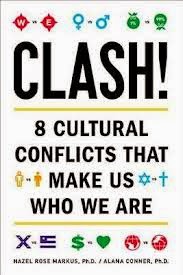
BookPastor >> "Clash!" (Hazel Rose Markus and Alana Conner)

TITLE: Clash!: 8 Cultural Conflicts That Make Us Who We Are
AUTHOR: Hazel Rose Markus and Alana Conner
PUBLISHER: New York, NY: Hudson St Press, 2013, (320 pages).

As the world becomes more inter-connected, people will increasingly cross paths. Various people groups will intermarry and cultures will merge and adapt to each other. In many situations, they may even clash and produce conflicts never encountered before. In view of the inevitable conflicts, maybe the road ahead is not to arm ourselves with weapons but to wear the hats of understanding wherever we go. We anticipate changes. We welcome diversity. We seek first to understand than to be understood. This is where this book comes in. The key idea is, because cultural conflicts make us who we are, it is imperative to come up right through constructive interactions and engagements.

In an insightful study of eight different cultural conflicts, the authors who are also cultural psychologists describe the differences, reveal the various perspectives, and how we can understand the differences so that we can not only better appreciate them, but to learn to live and let live where necessary. At the root of their quest is the desire to locate ourselves and to find our identity that is being shaped by these cultural clashes. Describing the left side culture in terms of "I" (self, mind, psyche, and soul), and right-side "culture cycle" in terms of (I's, Interactions, Institutions, and Ideas), the authors contend that culture shaping begins from the left, conditioning the right, which in turn perpetuate this cycle. What if the shaping is non-constructive but destructive? What if our cultural blindness leads to misunderstanding and wars? Differences indeed can annoy people. What is needed is to break this negative culture cycles and to replace them with positive constructive efforts to live together well in eight ways.  

Thursday, September 19, 2013

Touching Testimony on Christian Love

What is Christian hospitality? It is simply sharing the love of God with people who come among us. It is receiving them as a fellow brother or a sister who may be visiting. It is caring for a fellow human being, just like Jesus cares for strangers. This video begins with some shocking video footage of how some Muslims were taught to infiltrate and to overthrow the anti-Muslim regimes, especially the US. He was sent to the US to do "cultural Jihad" to try to change America from inside. Moving to the Bible Belt in the US, he considers himself the "sword of Islam" and to raise a group of cultural jihadists to change the US from the inside. Instead, God touches Kamal Saleem with an unexpected source: Christian love. He came to Christ.


conrade

Friday, January 27, 2012

Six Reasons Why the Young Are Leaving the Church

TITLE: Six Reasons why the Young Leaving the Church
Written by: Conrade Yap
Date: 27 Jan 2012

In a provocative book that attempts to diagnose the rumblings on the younger generation, David Kinnaman in his book, "You Lost Me: Why Young Christians are Leaving Church. . . and Rethinking Faith" points out 6 reasons why the young are leaving Church. Focusing on the generation that is between 18-29 years old, Kinnaman identifies three groups of people, the 'nomads,' the 'prodigals,' and 'the exiles.'

'Nomads' basically are those who are not actively engaged in Church but still believe. 'Prodigals' are those who introduces themselves as a 'former Christian' and no longer believe. 'Exiles' are those who are still in the Church but feel stuck between Church and the world.

Kinnaman then gives six reasons why the young are leaving the Church. They say that the Church is:

  1. "Over-Protective." About a quarter of the surveyed youths say that the church is overprotective of them, and tends to demonize the culture at large, from music to technology, from movies to their choice of programs, and especially things that they grow up with.  
  2. "Shallow." Boring, irrelevant, and lack of clarity in Bible teaching.  Many do not see a connection between God and their daily lives.
  3. "Anti-science." There is a strong perception that having faith in God is anti-thesis to the existence of science. 
  4. "Repressive." The church tends to be perceived as not as understanding and forgiving, especially in the area of sexual matters. Many young people feel judged. The Church in general does not understand the reasons behind the sexuality perspectives young people has. The rules of the Church seems to be stifling and judgmental.
  5. "Exclusive." Why is Christianity making exclusive claims? In a pluralistic world, why is the Church so stubborn and not willing to embrace other faiths and beliefs?
  6. "Doubtless." Why can't young people honestly verbalize their doubts? Must they be 'doubtless' and believe in the doctrine without questioning them?
[Read the Barna article here:]

It is an eye opener for those of us in our 30s and above. We may not need to agree with all of what Kinnaman is saying. What matters more is that these six reasons are consolidated from research done between 2007 and 2011 from 1296 young people (18-29 years old) in the US, both Church-goers as well as non-Church goers. Looking at the list above, as a Church, we need to be humble enough to be guilty until proven innocent.  

Six Opportunities to Renovate Our Houses

The first step with regards to such a report is to acknowledge that we have weaknesses. Confess that we have not done our best. Admit that there are things that we still do not understand. Whether the 6 reasons above are true or not true, all church leaders need to be mature enough at least to say: "I am open to criticism and open learning." Even for those churches with a thriving young people group, there is no guarantee that they can avoid all of the six factors above in the future. Let me suggest 6 constructive responses to the six reasons why the young are leaving.

#1 - Letting Go: Let adult members of the Church learn to let go of their own insecurities. That feeling of 'the kids not knowing what is best for them' has to go. We need to trust them, and to let them know that we trust them. Perhaps, the best way is simply to go up to them, and affirm them. Let them know that no matter what, we will be with them. Isn't letting go an act of love too? Love is not locking our kids up in a cage, so that they can be safe from the world. It is opening the doors, letting them fly out and experience the world. When the time is right, love will see them flying back home, in greater and fuller appreciation that love frees.

#2 - Growing Deep: This applies to all of us. I think there is a strong link between adult behaviour and the young observer. If the adults themselves are not growing and effectively relating their faith in the world, chances are, the young will copy and follow suit. If we want the young people to grow deeper amid the perception of shallowness in the Church, the adults have a responsibility to show the way.

#3 - Truth-Seeking: Whether it is science, philosophy, art, or theology, the whole Church needs to seek truth. There is truth in many things. Unfortunately, the world is littered with half-truths, half-perceptions, and half-done works of service. Truth needs to be whole. Supplement young people's perceptions by offering platforms for open discussions. Have friendly debates. Organize group dynamics sessions where apologetics can be practiced.

#4 - Open: There is no need to try to force other people into our own molds. It is stifling for anyone, not just young people. If there is a left, there is also a right. If there is an up, there is also a down. Sometimes, there is a middle position which recognizes the best and worst of both. Whatever it is, an environment of openness allows truth to be spoken in love.

#5 - Exclusive Claims: The key word is again 'truth.' Recognize that all religions are exclusive in their own ways. Even atheists and agnostics have their own brand of exclusivity. In this sense, Christianity is no different in terms of their truth claims. Those who trumpet pluralism and total tolerance have 'pluralism' and 'total tolerance' as their exclusive philosophy as well. In other words, everyone else is doing it. Why single out the Church?

#6 - Forgiving Climate: This is something that I am often troubled about. Are we breeding church environments where people are expected to be nice, politically correct, and permitted to do anything except those that ruffle up feathers? If all members of the church practise their attitude of openness and forgiveness, the young will see that it is ok to open up and share their doubts. In this manner, I believe that there is a kind of unhealthy unquestioning faith that leads to unhealthy doubt. There is also a kind of healthy doubt that leads to healthy faith.

There is hope. Let me close with Paul's encouragement to young Timothy. 
"For God did not give us a spirit of timidity, but a spirit of power, of love and of self-discipline." (2 Tim 1:7)
May we all learn to grow to trust in the power of the Holy Spirit, fellowshiping in the love of God, and continuing on like Jesus, on the path of self-discipline. So do not be afraid of the young leaving the church. If we maintain and renovate our physical and spiritual houses, keeping them in order, whether they are nomads, prodigals, or the exiles, the young will definitely WANT to come back home. I believe.


conrade

Saturday, January 14, 2012

A Simplistic and False Dichotomy

Currently, there is a video that has gone viral. It hypes up the age-old maxim of "Religion is Bad, while Jesus is good." Made by a young online evangelist called Jeff Bethke, it contrasts and compare the traditional understanding of religion with the desired brand of Jesus faith. This is remarkably similar to the "I'm not religious, I'm spiritual" movement. According to the Christian Post, the video has generated more than 66000 comments on the Youtube page alone. As of today, it has surpassed the 10000 mark to reach 102,167 comments.


A) Some Online Responses

Many responses have been posted on social media like Facebook and on blogs. Bloggers like Elizabeth Esther highlights 8 erroneous claims in the video, calling it a 'thinly disguised anti-Catholicism.' Others like Morgan Guyton prefers to probe the reasons behind Bethke's rant. Unwittingly, Guyton too performs a dichotomy. Instead of religion-is-bad-and-jesus-is-good argument, Guyton elevates 'what-jesus-has-done' over 'what we believe.' My friend, Joshua calls the dichotomy as plain 'stupid'

Other notable responses include two postings by Kevin deYoung. The first is a disagreement that triggers a brief exchange of emails between Bethke and DeYoung. The second is a followup that is more reconciliatory. DeYoung labels several parts of the video that are 'unhelpful and misleading.' He takes pains to dissect the statements to point out the mixed bag of both helpful and unhelpful stuff splashed out unabasedly on the video. The crux of DeYoung's argument is that one should not try to hype up a religion-free 'Jesus' at the expense of downplaying religion. Otherwise there will not be much 'Jesus left.'

The underlying tone is that of a cautious handshake. While trying to correct each other, there is a tone of reserved self-control on both sides. Whether we call it humility or speaking the truth in love, in a social media era, it is important to recognize the limits of e-communications. A video can speak a thousand words. The clarifying emails and comments may contribute a few more words. It is the face to face conversations that build bridges much clearer and more lovingly.

B) A Simplistic Portrayal

Videos like this is to me an overly simplistic portrayal of faith. While it appeals initially as a rhetoric or a creative rant about doing something right in a culture that contains some things wrong, it fizzles out when we probe a little deeper.

Some of my friends at Regent call this video a simplistic portrayal of a false dichotomy. Simplistic because people do not understand the contexts behind the historical events of wars and culture of Jesus. False dichotomy because the Bible does not condemn but redeems religion. See how James talks about 'true religion.'

"If anyone considers himself religious and yet does not keep a tight rein on his tongue, he deceives himself and his religion is worthless. Religion that God our Father accepts as pure and faultless is this: to look after orphans and widows in their distress and to keep oneself from being polluted by the world." (James 1:26-27)

Will Jesus hate such a 'religion?' What if the position that is advocated by Bethke adopts the very religious flavour that they are arguing against? If I were to refer to 'Jesus-only-ism' as the anti-thesis of religion, we get all kinds of confusing flavours. Flavours like:

  • Hypocrisy: Can your version of 'loving Jesus' only-ism become a religion in itself?
  • Church: Can your version of Jesus only-ism become an institution too?
  • Tradition and Doctrine: Can your 'Jesus only-ism, and all things 'love' become a dogmatic statement in itself?
  • Religion: Are you debunking all religion just because of a few bad apples?
  • Love: What makes one think that Jesus only-ism is able to hold both truth and love at the same time?
C) We Need Both

The truth is, both traditional religion and Jesus only-ism needs each other to clarify, to convict, and to co-operate in the realm of truth and speaking the truth in love. The moment we do a dissection in such a simplistic way, we are effectively planting the seeds of our brand of belief into a dogma. We need each other. We need to utilize our strengths to help our communities. At the same time, we need to let others speak and encourage us in our weaknesses. False dichotomies are unhelpful, and often too simplistic for any good. 

May our Church and various Christian communities learn to accept one another's differences without the need to be dogmatic about our various positions. Who knows? How Christians treat one another on the social media stage is how the world at large is seeing how Christians love one another. We can love one another without having to compel ourselves to compromise our own stand. Likewise, we can speak the truth in love, trusting the Holy Spirit to help us to have the humility to accept the things we cannot change, the courage to let ourselves be changed, and the wisdom to know the difference.

conrade

Thursday, July 28, 2011

"Hitchens vs Blair" Debate

Canada is increasingly one of the most secular states in the developed world. In fact, I feel it is leading the way in not only being 'secular' but also rather anti-institutional religion. One evidence lies in the way people perceive religion. On November 26th, 2010, world renowned atheist activist, Christopher Hitchens and former British Prime Minister Tony Blair, lock horns in Toronto Canada to debate the question:

"Be it resolved religion is a force for good in the world."

Hitchens vs. Blair: Be It Resolved Religion Is a Force for Good in the World (The Munk Debates)
Moderated by Rudyard Griffiths, both speakers were allowed 7 minutes to make their opening arguments which is then followed by two rounds of rebuttals and counter arguments. Questions are then fielded both online as well as from the audience. Here are some of their points.

Friday, June 18, 2010

Book Review: "Tea With Hezbollah"

Title: Tea With Hezbollah
Authors: Ted Dekker & Carl Medearis
Published: New York, NY: Doubleday Religion, 2010, (258 pages).

The premise of the book is simple. Based on Jesus greatest commandments to his disciples, the authors, who are of the Christian faith attempt to test this teaching on non-Christians, in particular the Arab neighbours in the Middle East and Israel. Covering the three major monotheistic faiths; Islam, Judaism and Christianity and some of all their variants, the authors undertake a dangerous journey in war-torn Beirut, Jerusalem, Jordan, Egypt and several other undisclosed locations to find out. The results of the short interviews reveal striking differences in terms of the perceptions of Jesus' greatest commandment.

For Christians, it seem to be a given, and a taken-for-granted statement that the rest of the world should naturally understand. The courageous journeys into dangerous 'enemy' territory can be said to be foolish to some, bravery to others. While the Western world of Christianity generally assumes that Jesus' teaching is THE biggest thing, and that the rest of the world should respect, it will come as a shock that it is simply a peripheral teaching to others. While the West talks of love before all things, leaders from groups labeled by America as 'terrorists' talks about justice + love going hand in hand. In a nutshell, love is meaningless without the element of justice. It is like a man walking with 2 legs, each of equal importance. Western perceptions of Jesus' greatest teaching seem to be a limping image of walking on the one single leg of love. This one difference is the major reason why the West and the Middle East religions do not always see eye to eye.

I read this book on my flight back from Boston. It is an entertaining read, as it incorporates both real interviews with Islamic rebels as well as a fictional story of Nicole interspersed throughout the book in 7 separate chapters. While Nicole's story is fiction, it reveals a realistic portrayal of how war and ideologies can break up and separate families.

My Comments
This book is a good resource to balance the overly Westernized perception of people living in the Middle East. It tells us how much MIS-understanding Western people, even well-intentioned Christian people has of the Muslims, even the terrorists. The theme running throughout the book is that the rebels put on a posture of 'defense' more than invading others. They claim that Islam stands for peace and they wish no war or bad outcomes on others. Misunderstandings exist on both sides. Errors have been made on both sides. Wrong propaganda has been launched from both sides. In some ways, everyone of us are guilty of unfair perceptions.


I think a mediator may be necessary to bridge the ideology divide. In the presence of a third party, feuding parties may be more willing to put down their animosity or prejudices in order to explain in a fair manner to the neutral party. If trying to understand each other is the solution to peace between the Islamic world and the West, it would have been done much earlier. Talking about it is one thing. The practical details are another. That is why countries such as China or India can play a big role in bridging the gap.


This book tries to correct negative perceptions arising from the Western thinking on the Islamic society. It aims to show that these groups do not seem to be reading on the same page. This is an entertaining and warm book. For we are all humans.


conrade

Latest Posts

Headlines